What counts as a complex extraction?
Most teeth that need to come out can be removed in a straightforward way. A complex, or surgical, extraction is needed when the tooth cannot simply be eased out. That includes:
- Impacted wisdom teeth that are stuck under the gum or against the tooth in front
- Teeth broken at or below the gum line, where there is little left to hold
- Teeth with long, curved or fused roots
- Teeth close to the nerve or the sinus, where careful planning matters most
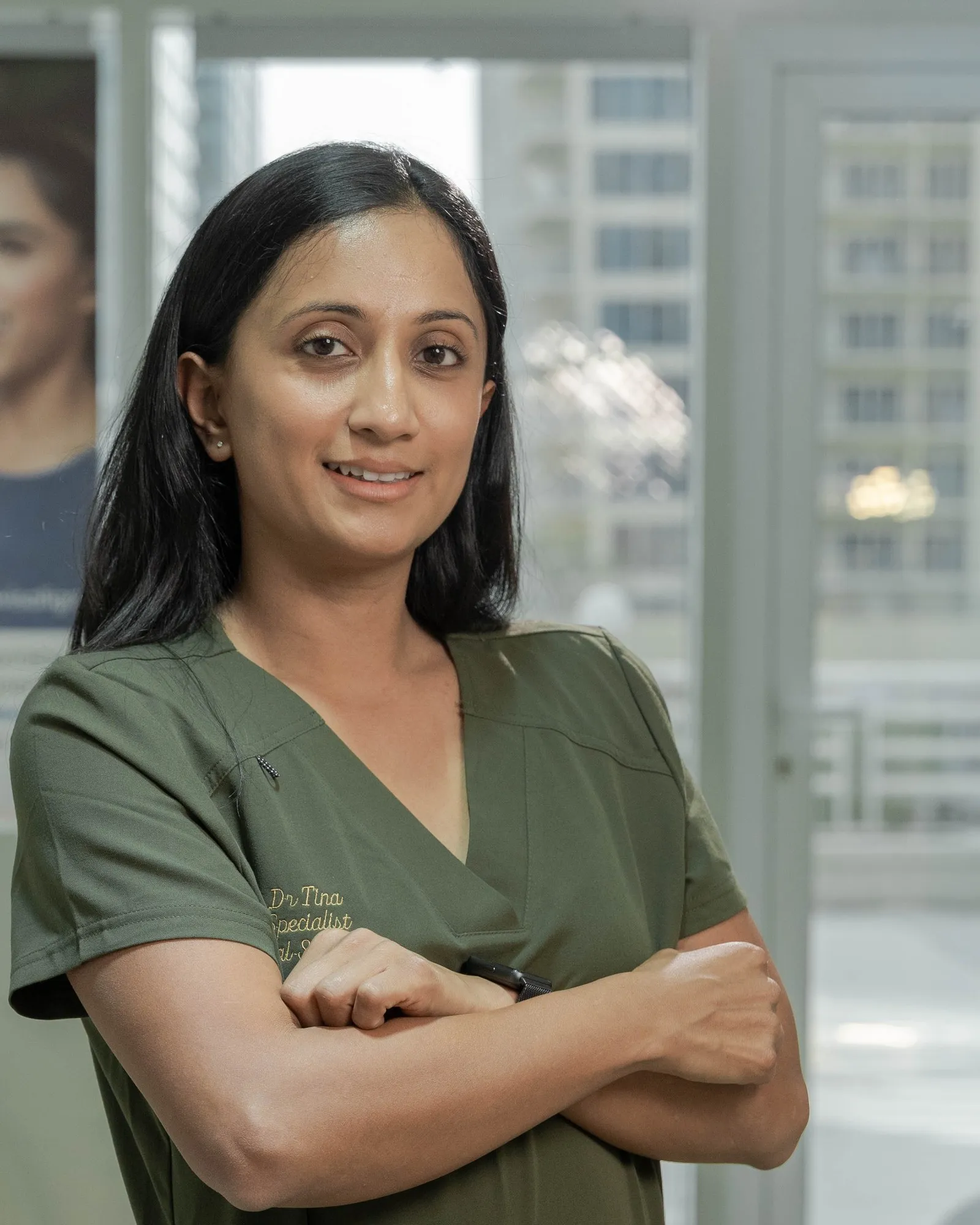
These cases are treated by Dr Tina Hirani, our Consultant Oral Surgeon, in the same calm clinic in JLT where you see your regular dentist.
When should a wisdom tooth come out?
Wisdom teeth usually arrive between the late teens and mid-twenties. If there is not enough room, they can come through at an angle or stay partly buried. That is not a problem in itself, and many are best left alone. We usually recommend removal when a wisdom tooth:
- causes repeated infection and swelling of the gum around it (pericoronitis)
- is decaying, or is causing decay or gum disease on the tooth next to it
- is pushing against the neighbouring tooth or has a cyst around it
Fig. 06 · Wisdom teeth
How a wisdom tooth sits decides how it comes out.
- IUprightOften comes through on its own. Removed only if it causes problems, usually in a simple extraction.
- IIAngled forwardsLeans into the tooth in front, trapping food and causing infection or decay. The most common reason for removal.
- IIIHorizontalLies on its side under the gum. Removed surgically, often in sections, so the bone around it is disturbed as little as possible.
- IVNerve canalRuns through the jaw below the roots. When a tooth sits close to it, a 3D scan is used to plan the removal.
Planned on an X-ray or 3D scan, carried out under local anaesthetic.
If you are not sure, an assessment with an X-ray will tell us whether removal makes sense or whether it is better to keep an eye on it at your check-ups.
How treatment works at Hey Dental
- Assessment. Dr Tina examines the tooth and takes an X-ray, or a 3D scan when the tooth sits close to the nerve or the sinus. She explains the options, the risks and what recovery will look like, and you receive a written fee before anything is booked.
- The procedure. The area is numbed with local anaesthetic. For a surgical extraction, a small opening is made in the gum, and the tooth may be divided into sections so it can be removed gently with as little disturbance to the bone as possible. The gum is then closed, usually with dissolving stitches.
- Aftercare. You go home with written instructions and a contact number. Most people return to work within a day or two.
If you feel anxious about treatment, we can discuss nitrous oxide (laughing gas) or oral sedation. We do not provide IV sedation or general anaesthesia at the clinic; if Dr Tina feels you would be better looked after with either, she will explain why and help you find a suitable specialist service. You can read more about managing dental anxiety.
Recovery and aftercare
Some swelling, stiffness and soreness are normal and usually peak around the second or third day. To help healing:
- Bite on the gauze for the time advised and avoid rinsing for the first day
- Do not smoke or use a straw for at least 48 hours, as this can dislodge the clot
- Eat soft, cool food and chew on the other side
- From the next day, rinse gently with warm salt water after meals
- Take pain relief as advised by your dentist
Call us if the pain gets worse after a few days, if swelling keeps increasing, or if you have a fever. Out of hours, see our emergency dental care page.
Risks we will talk you through
Every extraction carries some risk, and Dr Tina will discuss the ones that apply to you. The most common are swelling, bruising and a dry socket. With lower wisdom teeth there is a small risk of temporary, and rarely lasting, numbness of the lip, chin or tongue if the tooth sits close to the nerve, which is why a 3D scan is used to plan these cases.
After the tooth has gone
Wisdom teeth do not need replacing. If another tooth is removed, we will talk you through whether to replace it and how, for example with a dental implant or a bridge. Sometimes a tooth can be saved instead with root canal treatment, and we will always tell you when that is a realistic option.
Book an assessment
If a wisdom tooth is bothering you, or you have been told a tooth needs to come out, book an assessment with Dr Tina. We will explain what we find and give you a written plan and fee before any treatment.